 |
| Strike a pose, Latte! |
Showing posts with label hay. Show all posts
Showing posts with label hay. Show all posts
Tuesday, November 18, 2014
More on Latte the Calf
I was able to get Latte the newborn Jersey calf to stand still for a few seconds.
Latte is a sweet, energetic, rambunctious lil' gal.


Tuesday, June 10, 2014
Hay Day #1
A few weeks ago, I made my own hay using my scythe, some rakes, a tarp, and free child labor extremely wonderful, helpful children.
It was the first cutting of the year, and the first time cutting the complete hay field. Last year, I only got about 2/3 of it done. I did the whole cut in one shot, then the kids and I raked, tarped, and stored it on another day.
We then celebrated by playing baseball in the fresh-cut hay field. It was great.
It was the first cutting of the year, and the first time cutting the complete hay field. Last year, I only got about 2/3 of it done. I did the whole cut in one shot, then the kids and I raked, tarped, and stored it on another day.
We then celebrated by playing baseball in the fresh-cut hay field. It was great.
 |
| The older kids helped rake and tarp the hay. I carried the hay to the shed and stored it. |
Friday, May 30, 2014
Random Reflections
 |
| Got a lot on my mind right now. |
Thursday, May 8, 2014
And So It Begins....
This week, I moved the chickens to the second "paddock" area, and the pigs to the third. I then took down the fencing to the first, revealing the garden area below.
The utter destruction these two species cause in succession is startling. And for a garden, that's a good thing.
 |
| Pigs and chickens use their natural abilities to work the land. The combo panels keep in the pigs. The chicken wire keeps in the chickens. The end result? Fluffy, tilled, picked clean gardens. |
Wednesday, April 2, 2014
New Meat Rabbit Breeding Stock
We added yet another species to the farm last night. We bought two breeding rabbits: one 11-month Californian doe, and one 5-month New Zealand White buck.
We're still searching for a second breeding-age doe, but in the meantime, we have some new friends to get to know.
 |
| Our new breeding stock meat rabbits. Left, Skittles the Californian doe. Right, Coconut, the New Zealand buck. |
Wednesday, March 19, 2014
March Homestead Update
Happy Feast Day of St. Joseph!
St. Joseph is my adopted patron. I am not named after him, and chose another saint at Confirmation oh those many years ago. Since being married and working, though, I've come to appreciate how helpful St. Joseph and his holy example are. So, in celebration of his feast day, I'm dedicating this update of all of my work around the homestead to him.
First, the pigs are growing visibly larger and more comfortable with us daily. Holy moly, they are fun to watch.
I'll likely leave them in place for at least another week, partially because the area isn't rooted to my satisfaction, and partially because I'm not ready to move the chickens into the reinforced cattle panel pens yet - I need to add the chicken wire, at the very least. And speaking of the chickens.....
St. Joseph is my adopted patron. I am not named after him, and chose another saint at Confirmation oh those many years ago. Since being married and working, though, I've come to appreciate how helpful St. Joseph and his holy example are. So, in celebration of his feast day, I'm dedicating this update of all of my work around the homestead to him.
First, the pigs are growing visibly larger and more comfortable with us daily. Holy moly, they are fun to watch.
 |
| BB'q saying hello. Escargo nervously watches in the background. |
 |
| All them piggies hanging out. They're starting to root up the area (yay!), and go nuts for milk and eggs. It's hilarious. |
Monday, February 24, 2014
More About Bridget Da'Cow
Bridget, our new family milk cow, is a sweetie pie.
 |
| Bridget looking at the camera. Brisket nursing. |
Her full name is Bridget Da'Cow. Wife and I wanted to honor our Saint-o-the-Year, St. Brigid of Kildare. Plus, the 7-letter/5-letter combo fits with our family's naming scheme. Some people do all "J" names, or everyone ends in "Y," or something like that. We do it numerically.
She's really sweet, and everyone in the family has grown to love her instantly.
Monday, February 10, 2014
Refreshing the Nest Box Bedding
The nest boxes in my DIY movable chicken coop are built of wood. As such, the bottoms are hard (duh). So, to soften them and prevent eggs from cracking, I need to keep it full of hay.
Well, I've been slacking lately on that, and since I had to cut some to change the baby chicks' bedding anyway, I went ahead and topped off the 5 nest boxes.
Now, the hens will be able to lay in peace and comfort, and I will not have to worry about eggs cracking in the box. That would adversely affect the economics of the backyard egg laying flock, and we can't have that.
Well, I've been slacking lately on that, and since I had to cut some to change the baby chicks' bedding anyway, I went ahead and topped off the 5 nest boxes.
 |
| The Rhode Island Red in the upper right, and an Australorp in the lower left. For some reason, the nest box right above the feeder is the favorite. The favorite is without new hay, the other 4 are with new hay. Quite a difference. |
Thursday, February 6, 2014
The Economics of a Backyard Milk Cow
Earlier this week, I explored the economics of keeping backyard egg-laying chickens. Since I want to get and keep a milk cow for the family, I thought I'd do the same thing for a cow.
We're going to need to make a few concessions and constraints based on my situation here, though.
So, those things being assumed, let's dive in and see what we can see.
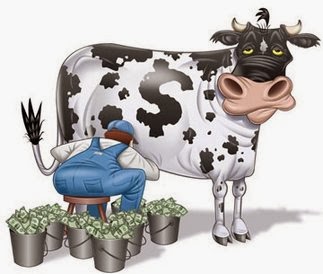 |
| Hey! I don't wear overalls! |
We're going to need to make a few concessions and constraints based on my situation here, though.
- A milking cow need at least an acre of good growing pasture. Add in a growing steer for beef, and you can effectively double that. So a cow/calf pair should have 2 acres of pasture during the growing season. Let's assume I have that.
- A milking cow must be fed hay in the winter at about the rate of 25-35 pounds of hay a day. We'll crunch the numbers using 30 lbs./day as the go-to hay rate.
- Hay can be harvested in three cuttings a year at the rate of about 5 tons per acre in zones 6 and 7 (we are in 6b), and potentially more if fertilized. I will assume less than the ideal and guess it's closer to 4. Let's also assume that I have a separate section of land for hay harvesting.
So, those things being assumed, let's dive in and see what we can see.
Tuesday, February 4, 2014
Why Are Self-Sufficient Family Farms So Big?
Short answer: horses.
Long answer: there are many factors involved. First of all, for a true "self-sufficient" farm, you need to produce everything you need from the land. That's all food, water, clothing, building supplies, medical supplies, cleaning supplies, heating, lighting, tools, books, recreational activities, etc., along with all of the other necessary to keep them up.
Of course, one person (or heck, even one family) cannot reasonable do it all. Taking on blacksmithing, woodworking, animal training, dairying, crop growing, shearing, weaving, looming, tanning, medicine, home building, and general day-to-day repairs, on top of the routines of life with laundering, cooking, cleaning, and normal family life, is a big task.
So self-sufficient farms really DON'T do it all. Instead, they produce extra of whatever, and then sell and/or barter to fill in the gaps. Or, they maintain a separate income source and narrow their focus. But I often encounter situation where advice or "standards" are based on the first camp.
"Oh, you definitely need at least 60 acres to be self-sufficient."
"You can't have sheep and cows on less than 10 acres."
"You have to a barn, and 5 acres for hay, and this for that, and ...."
Bah!
Long answer: there are many factors involved. First of all, for a true "self-sufficient" farm, you need to produce everything you need from the land. That's all food, water, clothing, building supplies, medical supplies, cleaning supplies, heating, lighting, tools, books, recreational activities, etc., along with all of the other necessary to keep them up.
 |
| I think most farms are needlessly large and hyper-specialized these days. |
So self-sufficient farms really DON'T do it all. Instead, they produce extra of whatever, and then sell and/or barter to fill in the gaps. Or, they maintain a separate income source and narrow their focus. But I often encounter situation where advice or "standards" are based on the first camp.
"Oh, you definitely need at least 60 acres to be self-sufficient."
"You can't have sheep and cows on less than 10 acres."
"You have to a barn, and 5 acres for hay, and this for that, and ...."
Bah!
Wednesday, January 22, 2014
Hay Lessons Learned
The sheep really like this new hay I got for them.
They are actually eating less of this new hay than the hay I cut last summer. Most of that, though, was cut too late, I am discovering in retrospect. I waited until the grass and weeds standing in the field were waist-high (shoulder-high in some spots). It was tough work. I injured my elbow and dinged up the scythe pretty bad, too. This new hay is shorter than what I had, and less brown in most spots.
 |
| Meatloaf, right, and Pot Pie, left, enjoy the mornings hay delivery. |
My lessons-learned, new rule for 2014 and beyond is to cut the hay when it's knee-high. That should give me 1) better hay, 2) more hay, and 3) an easier time cutting the hay. Hacking through 6-foot, woody branches is tough work, and I do NOT want a repeat of that experience.
Friday, January 17, 2014
More Hay! Ole!
I had to go get some more hay this afternoon.
It looks really good, and it better daggone last the rest of the winter. I'll be moving donkey out to graze the residual overgrowth until springtime. The hay is for the sheep.
The kiddos have to clean out the van tomorrow anyway, so they'll just be adding some loose hay to their chores. :) Hey, we all gotta do our part.
 |
| A 25 minute drive, 11 square bales, $41, and 1 minivan. You do the math. |
The kiddos have to clean out the van tomorrow anyway, so they'll just be adding some loose hay to their chores. :) Hey, we all gotta do our part.
Thursday, January 16, 2014
Middle Mid-January Homestead Update
 |
| Most of the time, the chickens keep a safe distance. This afternoon at egg time, this gal strolled right up and said hello. |
Whelp, I'm out of hay, we made our altar, and we're working through our circadian rhythms.
Monday, December 30, 2013
New Year's Homestead Update
What a crazy year it has been.
This weekend, I took inventory of where things are. First things first, a chicken update. We are now getting 8+ eggs a day consistently. I got 19 in just the last two days. Here was yesterday's next boxes:
Aside from the few random eggs on the coop floor, the girls have managed to lay in the boxes very consistently. It's SO nice to literally see our reliance on a factory-produced grocery store item disappear. At a current WINTER pace of 50 eggs a week for an 8-month-old flock, we're doing amazingly well.
This weekend, I took inventory of where things are. First things first, a chicken update. We are now getting 8+ eggs a day consistently. I got 19 in just the last two days. Here was yesterday's next boxes:
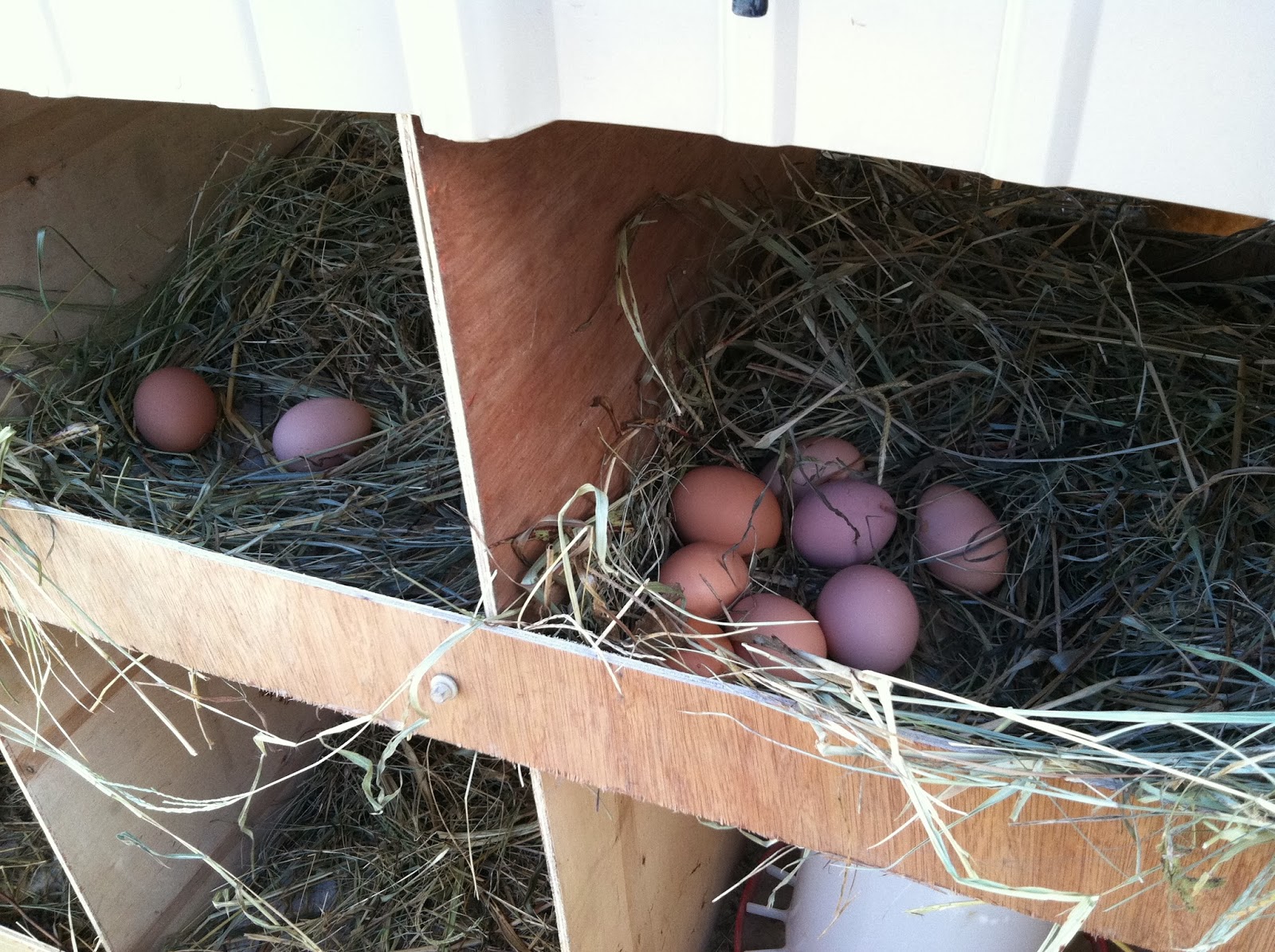 |
| Count'em - that there's 10 eggs! |
The repaired coop is also holding up quite well.
Tuesday, December 17, 2013
2013, We Hardly Knew Ye
 |
| "...from such films as Andre the Giant, We Hardly Knew Ye...." |
Either way, it was a crazy-town, whirlwind year here at the homestead.
This time last year, I knew there was so,so much to get done, so I dubbed 2013 "The Year of Getting Things Done."
Boy howdy, was it ever.
I have a yet-unfinished list, sure, but I did complete some very major accomplishments this year. We will continue our self-sufficient journey in 2014 with some exciting new additions and expansions.
For now, though, let's look back at 2013: The Year of Getting Things Done.
Friday, December 6, 2013
Overwinter Sheep Feeding
Feeding the sheep over the winter was something that I knew I needed to plan for and do from the beginning. So, I spent extra time this year gathering and cutting a bunch of hay.
The feeder I made in the sheep's dry lot is perfect.It holds just about a day's worth of hay for them...right now. They waste very, very little of it - the bottom and the ground collect mostly the thick stems left over that provide no nutrition anyway. I'd say actual edible HAY waste using this method is below 5% at the moment. Not too shabby. I may need to expand as they mature, but we'll cross that bridge later.
My biggest concern right now? Having enough hay to last the winter. :\
The feeder I made in the sheep's dry lot is perfect.It holds just about a day's worth of hay for them...right now. They waste very, very little of it - the bottom and the ground collect mostly the thick stems left over that provide no nutrition anyway. I'd say actual edible HAY waste using this method is below 5% at the moment. Not too shabby. I may need to expand as they mature, but we'll cross that bridge later.
 |
| Nom nom nom....fresh hay,alright! |
Saturday, November 30, 2013
My DIY Sheep Dry Lot
The grass stops growing right about Thanksgiving in middle TN. I needed an overwinter sheep solution. Plus, I weren't gunna let that there hay I cut go to waste.
Enter the sheep shack:
I built it with chain link fence pieces that were here when we moved in! I started theproject on Friday,thinking I'd be doing bits and pieces until next weekend. Luckily, some diligent work let me finish it late this afternoon.
Enter the sheep shack:
 |
| The sheep shack houses the sheep over the winter months (December through February). |
Tuesday, November 26, 2013
Late November Homestead Update
Whelp.Winter is here.
The leaves are gone. The grass is brown. The chicken waterer is freezing overnight. The heaters are out in the house.
I have a lot to do to get ready for winter. It's here too fast this year.
The leaves are gone. The grass is brown. The chicken waterer is freezing overnight. The heaters are out in the house.
 |
| Thing #3 helping me winterize. |
Thursday, September 26, 2013
Hay Field Cutting
I did this a few weeks ago, and I'm late putting up pictures. I was also late getting the scythe out to cut hay. Hope it doesn't mean problems come January.....
After some tough afternoons, one in which I injured my elbow nerves somehow, I ended up with a nearly-full hay rack. I did NOT finish out the field due to elbow pain. But the resulting windrows looked great.
 |
| Before I started, the foliage was about chest-high. I needed to do this when it was knee-high. Lesson learned.... |
 |
| Center: a good quality windrow. Left: The uncut section. Right: an uncut section that over-ran some felled branches from the orchard project. |
Things #1 and #2 were HUGE helps getting it picked up and stored in the shed. They're good little farm kids, for sure.
I will need to do another cutting before winter, but my elbow has to heal up first. I'm getting pain in it at random times throughout the days, although it is lessening.
Monday, September 16, 2013
Lessons Learned in Homesteading: I
 |
| Got plenty of the first two..... |
Tomatoes, okra, and peppers are best left to closely-spaced rows
Pick veggies while they're young and tender (great big okra just doesn't taste as good)
Get cages for tomatoes set out before they grow too big
When building a chicken coop, make sure the sheep can't get in BEFORE you fill the chicken feeder
When training guineas to stay home, a dog crate is not sufficient protection for young guineas
Stay on top of weeding early!
Cut hay early, before it grows shoulder-high
That's it for now. There are more, and I'll get them down as they come to mind.
Subscribe to:
Posts (Atom)